
Platform review · The OKR Software Benchmark

Perdoo
OKR and strategy execution platform
Perdoo helps organizations implement OKRs and execute their strategy. It offers a balanced feature set for mid-sized to large companies.
About our ratings: Our scoring focuses specifically on OKR capabilities. If a platform offers OKRs alongside other features (like performance management or project management), we evaluate how well it handles OKRs specifically, not its full feature set.
Where Perdoo ranks
| Ranking | Position | Score |
|---|---|---|
| Best OKR software for mid-market | #2 of 13 | 4.1 |
| Best OKR software overall | #4 of 13 | 3.8 |
| Best OKR software for startups | #4 of 13 | 3.8 |
| Best OKR software for remote teams | #4 of 5 | 4.1 |
| Best affordable OKR software | #4 of 13 | 4.3 |
| Best OKR software for enterprise | #5 of 13 | 4.1 |
| Easiest OKR software to use | #6 of 13 | 3.6 |
Positions are computed from each category's published criteria weights — including the ones Perdoo loses.
Perdoo also appears in 6 integration rankings, with Salesforce (#3 of 6), Slack (#3 of 11), Google Sheets (#4 of 6), Jira (#5 of 9), Tableau (#5 of 5) and Microsoft Teams (#6 of 11) as the exceptions. Integration rankings mostly reflect connector coverage — see the full rankings index.
Should you choose Perdoo?
Perdoo is a solid middle-ground option for teams that want structured OKR workflows with predictable pricing. It is generally strongest for organizations that value balanced capability over cutting-edge AI or highly flexible models.
Where Perdoo fits well
Perdoo works well for SMB and mid-market teams that need dependable OKR basics plus reasonable reporting.
Its feature balance and transparent pricing can simplify procurement and rollout planning.
Tradeoffs to consider
Teams looking for modern AI depth or highly flexible goal structures may find Perdoo more limited.
Annual-plan orientation and stricter cascading models can be less ideal for agile teams that iterate strategy frequently.
How to validate fit
A practical test is to run one quarterly planning cycle with both leadership and team-level goals.
This reveals whether Perdoo’s structure supports your pace without creating unnecessary process friction.
Perdoo is a credible option for teams that want a stable, structured OKR platform. The key decision is whether its workflow model matches your planning style and flexibility needs.
Compare Perdoo head-to-head
Side-by-side comparisons against the field, feature by feature.
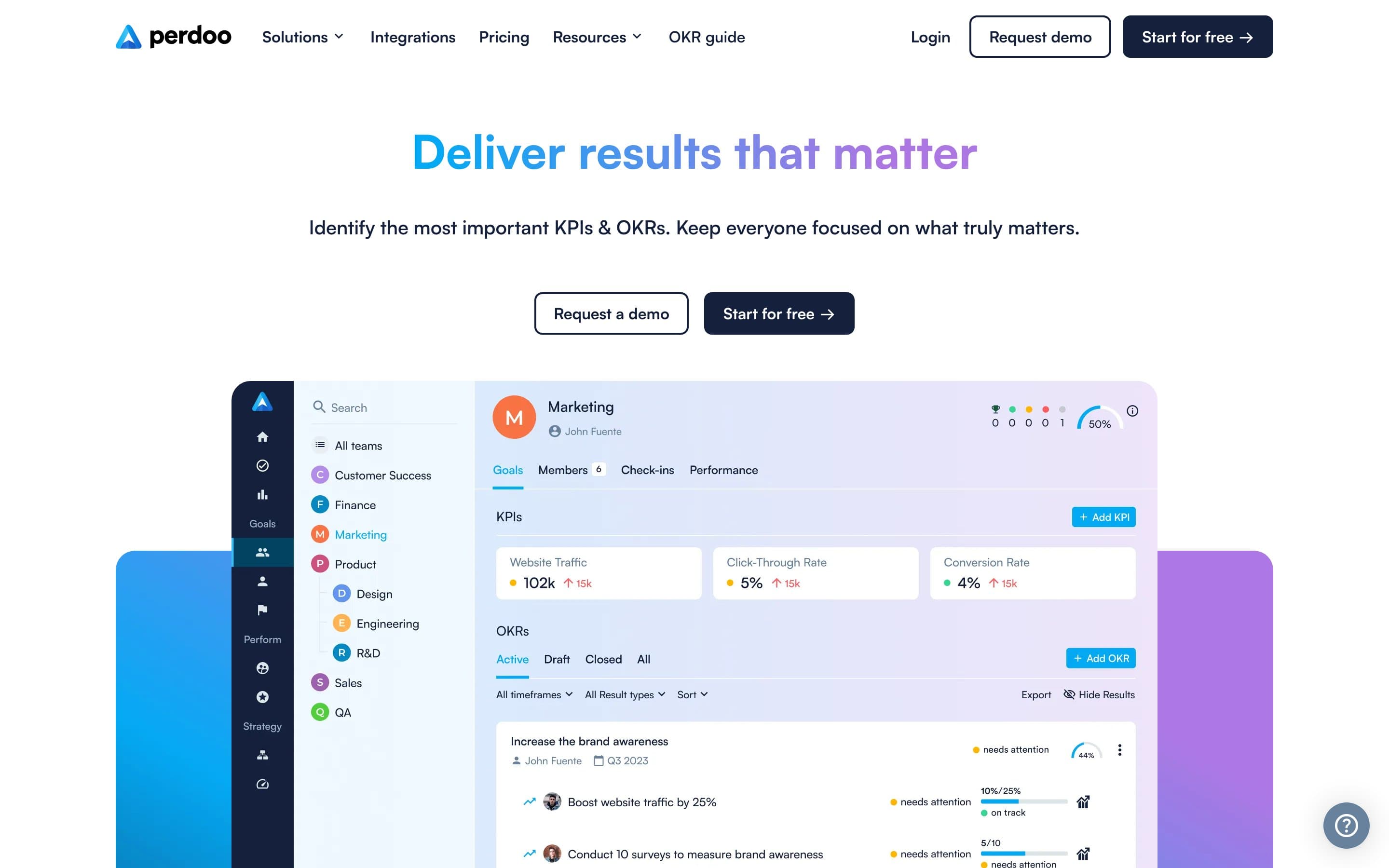
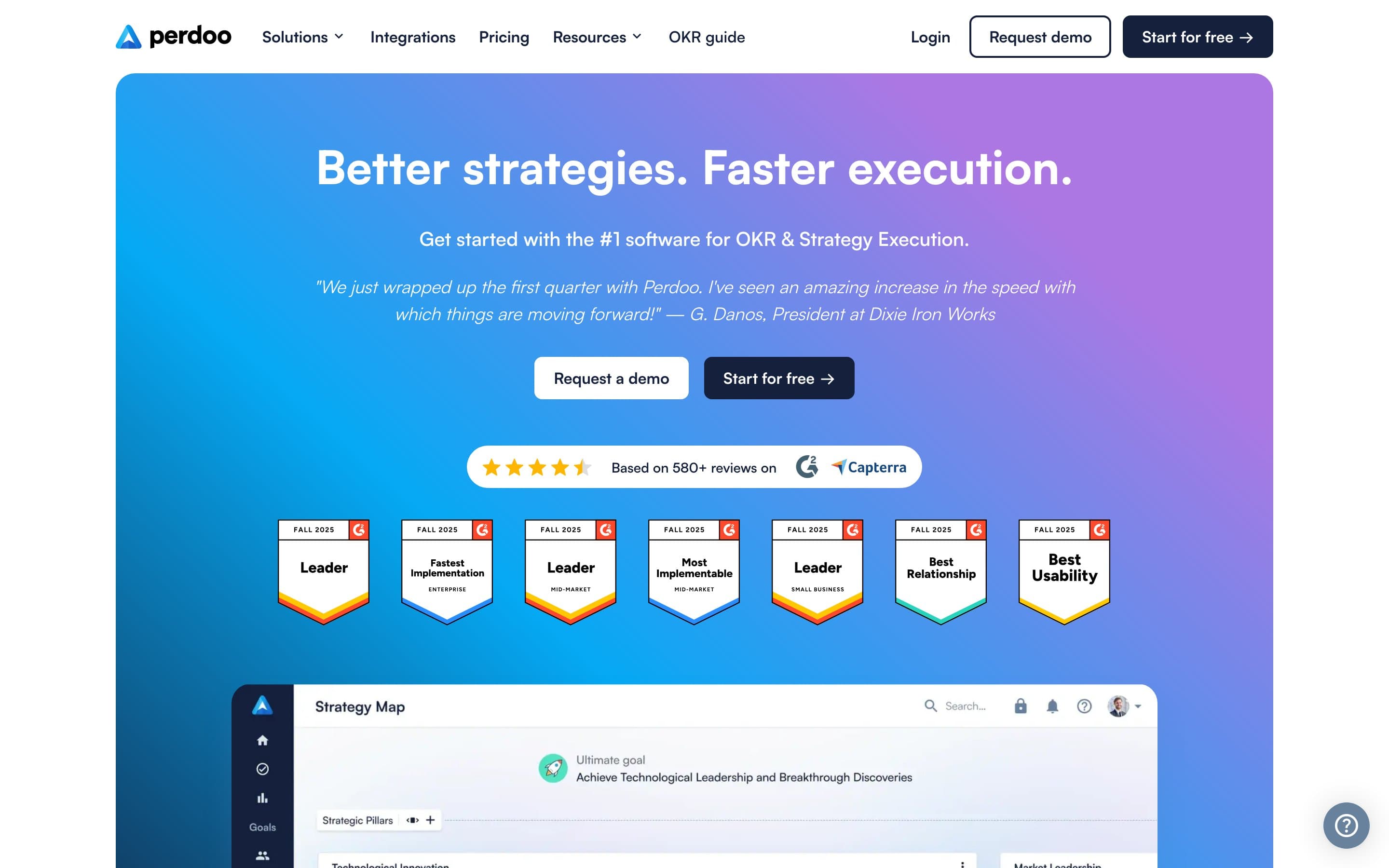
Perdoo in pictures
Pricing
- Free tier available, with paid plans from $9.3 per user/month.
- Full-featured tier at $11.6/user/month.
- Minimum annual spend: $557.
- Enterprise plans with custom pricing available.
Priced in EUR: free plan up to 5 users, Premium EUR 8/user/mo, Supreme EUR 10/user/mo (billed annually, ~11% more on quarterly billing — no monthly billing). USD figures are conversions at ~1.16 USD/EUR. Minimum 5 paid licenses. A $10,000 minimum contract applies only when procurement or security-review assistance is required. View-only licenses EUR 1.50/mo.
Source: Perdoo's pricing page — last verified 2026-07-31
Ratings
Benchmark editorial ratings
Scored 0–5 by this benchmark, OKR capabilities only — see how we rate.
Third-party ratings
Strengths & watch-fors
Strengths
- Good balance of features
- Reasonable pricing for mid-sized to large companies
- Good customer support
Watch for
- No month-to-month pricing
- Less intuitive than some competitors
- Limited AI features
- Fewer modern integrations
- Strict cascading models makes it less flexible for agile teams
Capabilities
Not included: Goal-tracking AI · Internal LLM · Remote MCP Server
OKR capabilities
- ✓OKR Management
- ✓Goal Tracking
- ✓KPIs & Metrics
- ✓Regular Check-ins
- ✓Tasks Support
- ✓Team Collaboration
Reporting
- ✓Reports & Analytics
- ✓Custom Views
- ✓Templates
Integrations
- ✓Integrations
- ✓Slack Integration
- ✓Microsoft Teams Integration
- ✓Data Connectors
- ✓Public API
AI capabilities
- ✓Goal-setting AI
- —Goal-tracking AI
- —Internal LLM
- —Remote MCP Server
13 listed integrations: Slack, Microsoft Teams, Azure DevOps, Excel Online, Google Sheets, HubSpot, Jira, MS Planner, Power BI, Salesforce, Tableau, Trello, Zapier.
Best for
Team types
product teamsleadership teams
Company types
SMBmid market
Use cases
okr implementation
Top alternatives to Perdoo
Ordered by our overall ranking model. Read the full alternatives guide →
- 01

Tability
Top pick4.5Tability is a modern goal-tracking platform designed for teams who want to manage OKRs without complexity. It focuses on simplicity, accountability, and actionable insights.
In this category it scores highest on ease of use (5), and lowest on customer support (4).
Strengths: Simple, intuitive interface · Enterprise-ready with EU, AU, and US hosting options
Watch for: Limited integrations with HRIS systems · No free plan
$6/user/month · 14-day trial · G2 4.7 (161) · Gartner 4.9 (46)
- 024.2
Profit.co is a comprehensive OKR platform that combines objectives and key results with performance management. It offers a wide range of features for enterprise teams.
In this category it scores highest on integrations (5), and lowest on customer support (4).
Strengths: Complete integrations · Employee performance management features
Watch for: Expensive to deploy · Min. annual spend of $10,000
Est. $9/user/month (est.) · 30-day trial · G2 4.7 (471) · Gartner 4.7 (109)
- 034.1
WorkBoard is an enterprise-grade OKR platform designed for large organizations. It offers comprehensive planning, execution, and analytics capabilities.
In this category it scores highest on integrations (5), and lowest on task support (3).
Strengths: Comprehensive enterprise features · Strong analytics
Watch for: Steep learning curve · Expensive solution to deploy
Est. $30/user/month (est.) · G2 4.3 (342) · Gartner 4.2 (89)
- 043.7
Mooncamp is a modern, user-friendly OKR platform designed for fast-growing companies. It focuses on simplicity and ease of use while providing powerful OKR management features.
In this category it scores highest on ease of use (5), and lowest on task support (2).
Strengths: EU based (GDPR compliant) · Modern, clean interface
Watch for: Only annual plans available · No support for tasks
$8.1/user/month · 14-day trial · G2 4.8 (296) · Gartner 4 (2)
- 053.7
OKRs Tool is a flat-fee OKR platform for teams on a budget, and it is showing promise with rapid updates — 2026 alone added KPIs, reports, built-in AI, and 10 integrations including Jira and a hosted MCP server. It is still a young product with a small team and only a handful of third-party reviews.
In this category it scores highest on customer support (4.5), and lowest on integrations (3.5).
Strengths: Flat-fee pricing that undercuts per-seat rivals as teams grow · 10 live integrations including Jira, Asana, Linear, ClickUp, Notion, and Google Workspace
Watch for: No native task management — work is tracked by linking Jira, Asana, Linear, or ClickUp tasks · SOC 2 Type II audit still in progress
$49/flat fee · Free tier · G2 4.6 (7)



Frequently asked questions
How much does Perdoo cost?
Perdoo has a free tier, with paid plans starting at $9.3 per user/month.
What teams is Perdoo best for?
Perdoo is best suited for product teams, leadership teams teams, based on feature fit and our scoring model.
What are the top alternatives to Perdoo?
Top alternatives include Tability, Profit.co, WorkBoard.
Evaluating Perdoo? It has a free tier, so a hands-on trial costs nothing.