OKR stands for Objectives and Key Results. It is a goal-setting framework where an Objective describes where you want to be, Key Results are the measurable outcomes that prove you got there, and initiatives are the work you bet on to move those results.
That is the whole definition. The rest of this chapter explains why the framework is built that way, what a good OKR looks like, and how the pieces work together through a quarter.
What does OKR stand for?
OKR stands for Objectives and Key Results.
-
The Objective is the goal. It is a short, qualitative statement of the future you want. "Customers love our onboarding" is an Objective.
-
The Key Results are how you know. Each one is a measurable outcome with a starting value and a target. "Increase activation rate from 32% to 50%" is a Key Result.
Most teams add a third element that the acronym leaves out: initiatives, the projects and tasks you run to move the Key Results. We treat initiatives as part of the system, because goals without a plan are wishes and a plan without goals is a to-do list.
The framework was created by Andy Grove at Intel in the 1970s and brought to Google by John Doerr in 1999. If you want the full story, read our complete OKR history.
What is the purpose of the OKR framework?
Start from the problem. A company is a group of people making thousands of small decisions every week, most of them without asking anyone. Which bug to fix first. Which customer to call back. Which feature to cut when time runs short.
No leader can review all of those decisions. So the quality of a company's execution depends on whether people make good calls on their own, and that depends on whether they know what the organisation is trying to achieve right now.
That is the purpose of the OKR framework. It gives everyone the same short answer to three questions:
-
Where are we trying to go this quarter?
-
How will we know we are getting there?
-
What are we doing about it this week?
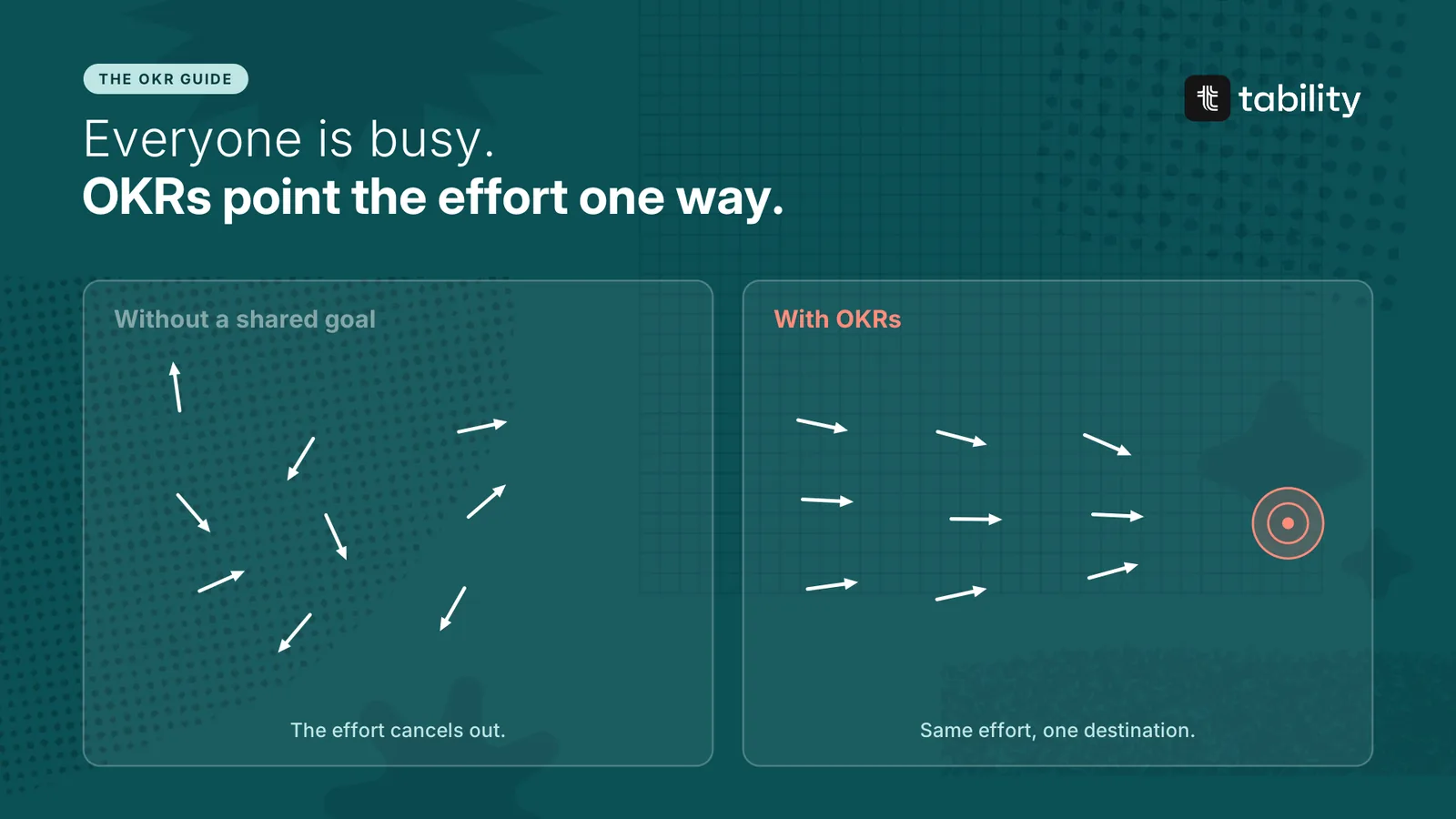
Without that shared answer, teams still work hard. They just pull in slightly different directions, and the effort cancels out.
Everything else people attach to OKRs – scoring systems, cascades, software, ceremonies – is optional. If your OKRs give people the same answer to those three questions, they are working.
The three parts: Objectives, Key Results and initiatives
Each part does a different job, and each one changes at a different speed.
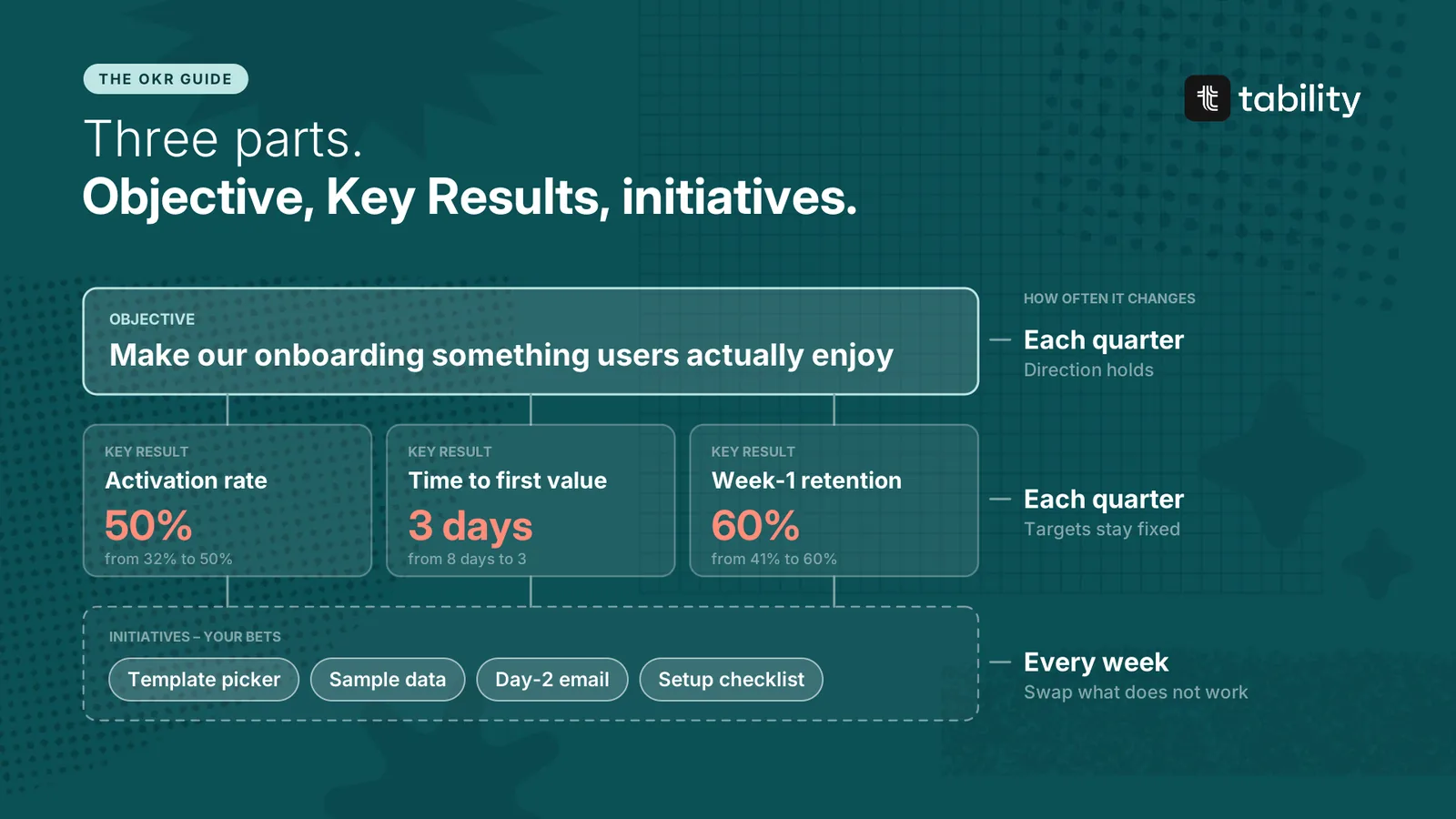
Objectives set the direction. An Objective is written in plain language, with no numbers, so that anyone in the company can read it and understand what matters. A good one describes an end state: "Enterprise buyers see us as a safe choice" tells a designer, an engineer and a salesperson something useful. An Objective should hold for the whole quarter. See how to write good Objectives.
Key Results measure the outcome. A Key Result is a metric with a start and a target. It measures the effect of your work on customers or the business, never the work itself. "Ship the new checkout" is an output. "Lift checkout conversion from 2.1% to 3%" is an outcome. Key Results also stay fixed for the quarter, because moving the target halfway through makes the score meaningless. See how to write good Key Results.
Initiatives are your bets. An initiative is a project you believe will move a Key Result. The important word is believe. You do not know yet. Some initiatives will work, some will do nothing, and the weekly review is where you find out. Initiatives are expected to change during the quarter: you stop the ones that do not move the number and start new ones. More on this in OKRs vs. initiatives.
The separation is what makes the framework useful. When the goal and the plan are the same thing ("Launch the Stripe integration"), finishing the plan feels like success even if nothing improved. When they are separate, you can finish a project, see that the number did not move, and try something else while there is still time.
How many? Up to three Objectives per team per quarter, with two to four Key Results each. Fewer is better. Every extra goal dilutes the others, and a team with eight priorities has none.
A simple OKR example
Here is a complete OKR for a product team.
Objective: Make our onboarding experience something users actually enjoy
↪ Key Result 1: Increase activation rate from 32% to 50%
↪ Key Result 2: Reduce time-to-first-value from 8 days to under 3
↪ Key Result 3: Lift week-1 retention from 41% to 60%
Initiatives (first bets):
• Replace the 7-step setup wizard with a template picker
• Add sample data to new workspaces
• Send a day-2 email built around the user's first goal
The Objective tells you the intent. The three Key Results define what "enjoy" means in numbers. The initiatives are the first guesses at how to get there, and they can be swapped without touching the goal.
You will find hundreds more in our full OKR examples library, and ready-to-use plans in the OKR templates.
Good vs. bad OKRs
The most common mistake is writing the plan as the goal.
Example 1: a bad OKR focused on an initiative
Objective: Integrate with Stripe
↪ Key Result 1: Stripe integration scoped by week 2
↪ Key Result 2: Integration built by week 8
↪ Key Result 3: Integration live by end of quarter
This is a project with milestones. It can be 100% complete while the company earns nothing from it. It also only speaks to the engineers doing the build.
Example 2: a good OKR focused on impact
Objective: Get our first paying customers
↪ Key Result 1: 50 accounts upgrade to a paid plan
↪ Key Result 2: Reach $5,000 in monthly recurring revenue
↪ Key Result 3: 20% of trials convert to paid
Initiatives: Stripe integration, pricing page, upgrade prompts, launch campaign
The Stripe integration is still there. It moved down to where it belongs, as one bet among several. Now marketing, sales and support can all see how they contribute, and the team can tell whether the work paid off.
| Good OKRs | Bad OKRs |
|---|---|
| Understood across departments | Relevant only to a small group |
| Plain language, no jargon | Ambiguous or hard to understand |
| Measurable and easy to track | Binary or hard to assess |
| Focused on outcomes | A roadmap in disguise |
| Not tied to compensation | Used to manage performance |
| Few in number | Too many to track |
For the full method, read how to write OKRs, or start from the OKR Starter Kit and import a working set today.
How OKRs work during a quarter
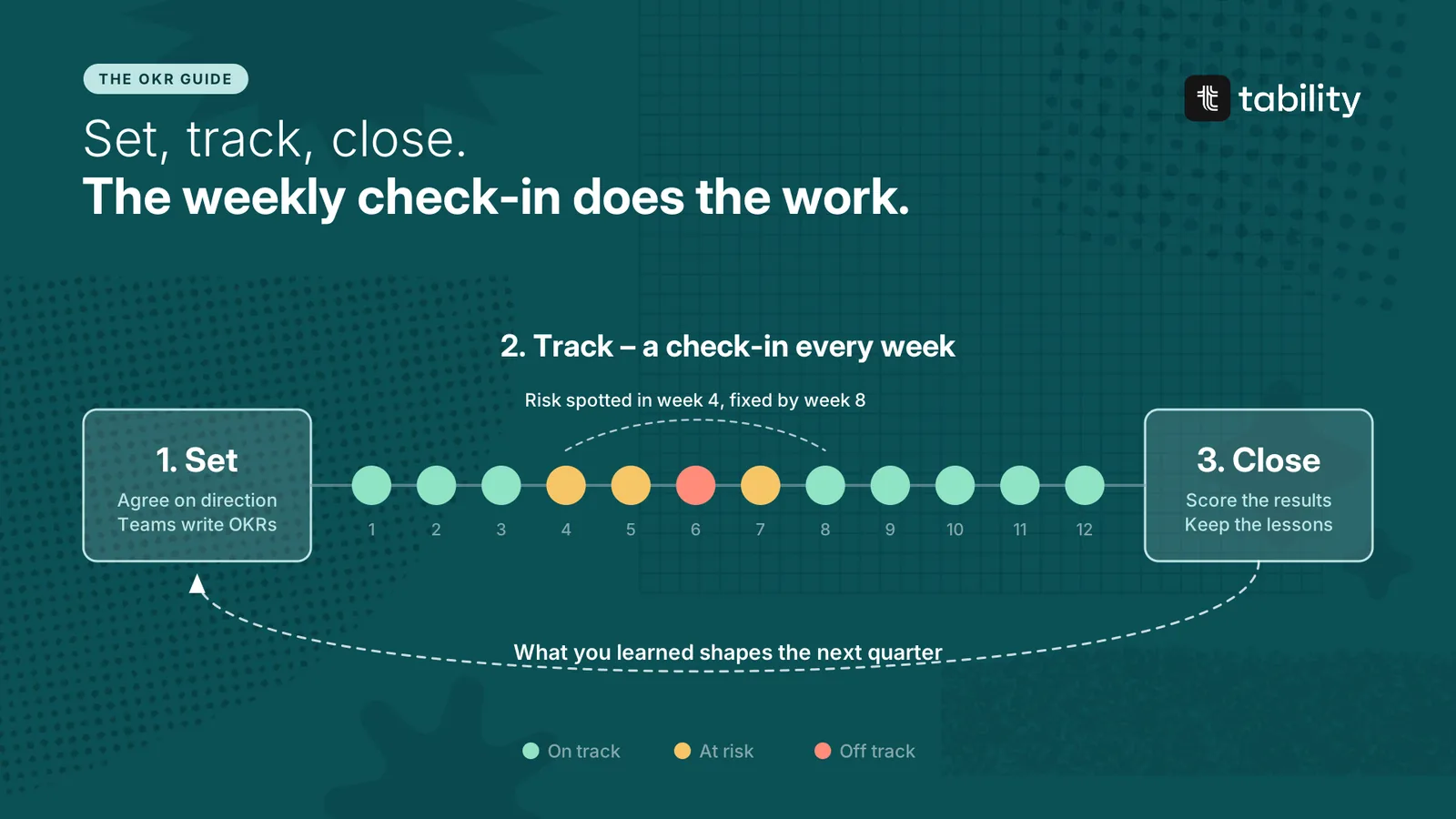
An OKR is only as good as the routine around it. The cycle has three phases, and most of the value comes from the middle one.
1. Set. Before the quarter starts, leadership shares the direction for the company. Teams then write their own OKRs in response. Spend your time agreeing on direction and less of it debating the perfect metric. An imperfect Key Result that everyone understands beats a precise one that took three weeks to negotiate.
2. Track, every week. Each Key Result gets a short update once a week: the current value, a confidence level (on track, at risk, off track) and a sentence on what changed. The team reviews those updates together and spends its time on what is at risk. Weekly matters because a quarter only has thirteen weeks. With monthly reviews you get two chances to correct course. With weekly reviews you get twelve. See our simple weekly ritual to track OKRs.
3. Close and reflect. At the end of the quarter you score each Key Result, look at which initiatives worked, and use what you learned to set the next goals. See OKR retrospectives.
OKRs vs KPIs: what's the actual difference?
KPIs tell you whether the business is healthy. OKRs tell you what you are trying to change.
A KPI is a metric you watch all the time, such as monthly revenue, churn or uptime. You want it to stay in a healthy range. An OKR is a time-bound goal to move something from one level to another. When a KPI needs to improve, it often becomes a Key Result for a quarter, then goes back to being monitored.
You need both. The full comparison is in OKR vs KPI: key differences, examples, and how to use both.
What are the benefits of OKRs?
-
Focus. A short list of goals forces you to say no to the rest.
-
Autonomy. Teams that know the destination can choose their own route, which means fewer approvals and faster decisions.
-
Early warning. Weekly confidence updates surface problems in week three, when you can still act, and not in week twelve.
-
Adaptability. Because initiatives are bets, changing tactics is expected and carries no stigma.
-
Better meetings. Reviews move from "what did you do" to "is it working".
There is more on why OKRs are effective and on the benefits for individual contributors.
What OKRs are not – and the mistakes that follow
A to-do list. If your Key Results read like tasks, you are tracking output. Business-as-usual work does not belong in OKRs either. Keep that in your KPIs.
A performance review tool. Tie OKRs to bonuses and people will set targets they are sure to hit. You lose the ambition and the honesty in one move.
A top-down order. Leadership sets the direction and teams write their own goals. A rigid cascade assumes the strategy is perfect and leaves teams waiting for instructions. Read how we align OKRs at Tability, because cascading sucks and the chapter on cascading vs. aligning OKRs.
Set and forget. OKRs written in January and opened again in March are a planning exercise. The weekly check-in is what turns them into a management system.
A Google replica. Google aims for 60–70% completion on its goals. Almost nothing else in your company is graded that way, so it confuses people. Aim to hit your targets. The reasoning is in the complete OKR scoring guide.
Company OKRs, team OKRs and annual OKRs
Company OKRs state the two or three things the whole organisation must achieve. They are the reference point for everyone else.
Team OKRs are how each team contributes. A team reads the company goals and asks what it can move this quarter. Team goals should connect to the company's direction without being a word-for-word copy.
Individual OKRs are best avoided. They turn into task lists and drift into performance management.
Annual vs quarterly. Use a yearly horizon for company direction and a quarterly one for team OKRs. A year is long enough to describe a meaningful change, and a quarter is short enough to learn from. Annual OKRs set at team level tend to be out of date by April.
What OKRs look like in 2027
The framework is the same one Intel used. The environment around it is very different.
AI has made building fast and cheap. Teams now ship far more in a week than a leader can review, so a clear destination matters more than it ever did. The cost of starting a project has dropped, and the cost of pointing ten projects at the wrong goal has gone up.
AI also takes some of the admin away. Tability's AI can draft OKRs in seconds from a paragraph of strategy, which gets you past the blank page. Tracking and reviewing stay with your team. If you later want agents to take on part of the process, Part 6 of this guide shows where they fit.
The next chapter covers this in detail: OKRs before and after AI.
Frequently asked questions about OKRs
What does OKR stand for? Objectives and Key Results. The Objective is the goal and the Key Results are the measurable outcomes that show you reached it.
Who invented OKRs? Andy Grove developed the approach at Intel in the 1970s. John Doerr introduced it to Google in 1999, and it spread from there.
What are initiatives in OKRs? Initiatives are the projects and tasks you run to move a Key Result. They are bets, so they can change during the quarter while the Objective and Key Results stay fixed.
How are OKRs different from KPIs? KPIs are ongoing health metrics. OKRs are time-bound goals to change something. Most companies use both.
How many OKRs should a team have? Up to three Objectives per quarter, with two to four Key Results each. A small team can start with one Objective.
Are OKRs and SMART goals the same thing? No. SMART is a checklist for writing a single goal well. OKRs are a system for connecting goals across a company and reviewing them every week. A good Key Result is usually SMART.
Should OKRs be tied to performance reviews or bonuses? No. It pushes people to set safe targets and hide problems.
How often should you check in on OKRs? Weekly. The update takes a few minutes per Key Result.
What is a good OKR software? One that makes the weekly check-in effortless and shows leaders where attention is needed. See our guide to the best OKR software.
Can OKRs work for small teams? Yes. The same framework runs in a five-person startup and in organisations with thousands of people. Smaller teams simply need fewer goals.